
|
|
AfroCubaWeb
|
|
Voice of the Leopard: African Secret Societies and
Cuba
|
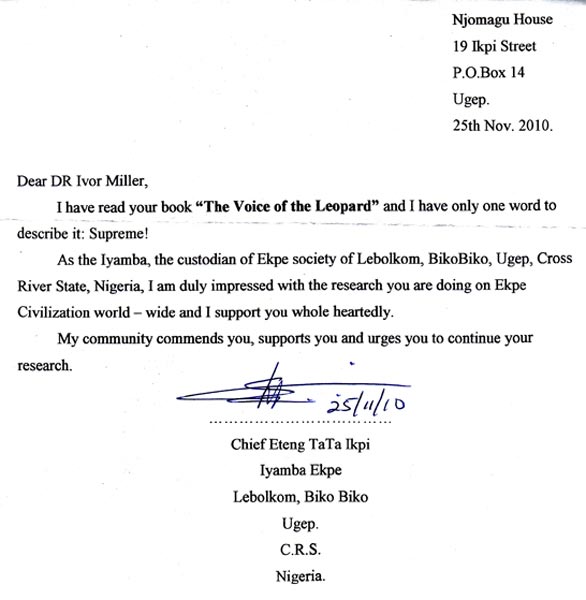
Chief Eteng TaTa Ikpi, Iyamba Ekpe, Nigeria, 11/25/2010
Voice of the Leopard: African Secret Societies and Cuba -
Reviewed by Kristine Junker, University of Nottingham's Centre for
Research on Cuba, MIT Press Journals, 4/29/10
www.mitpressjournals.org/doi/abs/10.1162/afar.2010.43.2.89
Transatlantic Connections: African Secret Societies in Cuba 6/1/2010 H-Net: "In Voice of the Leopard, Ivor L. Miller examines the history of
Abakuá, a secret or initiate based religious society formed in Cuba, through the lens of the Ékpè Leopard Society of West Africa’s Cross River basin (a region today encompassing Nigeria and Cameroon). Employing a self-described “historical anthropological” approach, based largely on oral narratives and insider status as an Ékpè initiate, and arguing that the Abakuá were a direct extension of the
Ékpè, Miller’s purpose is twofold: to demonstrate African cultural transmissions and survivals in the Americas and to emphasize the centrality of Abakuá in the larger narrative of Cuban history."
Review: Voice of the Leopard: African Secret Societies and Cuba - by Sybille Ngo Nyeck 6/1/2010 Univ of California
Review by Dr. Toyin Falola, University of Texas, 2/2010
|
Social & Behavioral Sciences \ History, Geography & Area Studies \ Latin America & the CaribbeanMiller, Ivor L. Voice of the leopard: African secret societies and Cuba. University Press of Mississippi, 2009. 164p bibl index afp; ISBN 9781934110836$55.00. Reviewed in 2010 Feb CHOICE. A product of long and committed research, this book provides a clear history on the formation of the Abakuá society in Cuba. A mutual aid and secret society, the Abakuá has its origin in the Ekpe leopard society in the Cross River basin of Nigeria. Highly textured and rich chapters explain the origins and evolution of this institution from the 18th century to the present. More importantly, Miller (Boston Univ.) fully elaborates the society's characteristics: a male initiation society with a public face expressed in masquerades, drum construction, musical structures, and a ritual language of chants. The society not only provides the opportunity to create a powerful network, it serves as a regulator of social control, an agency to maintain law and order, and a custodian of cultural and moral values. This is one of the finest books on a case study of African cultural transmission to the Americas, revealing the richness of West African roots, the strategy of the society's reconstruction in Cuba, and the linkages between a secret association and the formation of identity in a racialized Cuban nation. Summing Up: Highly recommended. Upper-division undergraduates and above. -- T. Falola, University of Texas |

| Ivor Miller. Voice of the Leopard: African Secret Societies and Cuba. Carribean Studies Series. Jackson University Press of Mississippi, 2009. Illustrations. xx + 364 pp. $55.00 (cloth), ISBN 978-1-934110-83-6. Reviewed by Jill Salmons Published on H-AfrArts (January, 2010) Commissioned by Jean M. Borgatti The Cross River Roots of the Cuban Abakua society One of Thompson's pupils, Ivor Miller, has now produced a noteworthy study, concentrating specifically on one particular secret society, Ekpe, of the Cross River region of southeastern Nigeria and southwestern Cameroon; its transfiguration on Cuban soil into the Abakua society; and the ensuing effect of Abakua in shaping all aspects of the social, political, and metaphysical traditions of Cuban urban life. The book's title, _Voice of the Leopard_, refers to the belief in both locations that the mystic voice of the leopard is the most important symbol of political authority in autonomous communities. The subtitle, _African Secret Societies and Cuba_, is something of a misnomer, since the text deals with only one West African secret society. The book itself charts Miller's original research in Cuba and its verification by more recent research in the Cross River. Miller went to Havana to study Yoruba influences in Cuba. However, introduced to a number of elderly men, descendants of Cross River slaves who were walking repositories of Abakua history and ritual, he recognized a unique opportunity. He spent the next few years interviewing these informants and substantiating their accounts by studying early ethnographies, police records, and colonial reports. An engaging aspect of Miller's introduction is his candid admission of the difficulties in piecing together information gleaned from different individuals, and marrying that information with available secondary sources to create an accurate description of the history and manifestation of Abakua as well as its role in Cuban life. The readers are introduced to key informants whose photographs are incorporated into the book. However, as Miller explains, the remarkably dense collection of material provided by such respected elders and the (recorded) responsorial chants performed by Abakua leaders took on poignant significance when, in 2004, he shared this knowledge with current members of the Ekpe society in the Cross River region. I was present when Miller first presented Abakua chants to eminent Ekpe chiefs in the museum lecture room in Calabar, the port of embarkation for most Cross River slaves. Their response was at first bewilderment, and then a negative incredulity that this unknown American scholar knew chants that indicated a deep understanding of the core elements of their organization. However, as Miller described the history of Abakua, its prominence in contemporary Cuban life, and the burning desire of Cuban Abakua members to meet their Cross River "brothers," the atmosphere in the hall became electric. The chiefs recognized not only the living proof of the cultural transmission of Ekpe beliefs and manifestations, but also its ongoing relevance in Cuba. Subsequently, Miller was initiated into the Ekpe society in several Cross River communities, enabling him to undertake further research on direct links between lodges in the two locations. After a foreword by Engineer Bassey Efiong Bassey, a prominent Ekpe titleholder, the book is divided into eight chapters. These are followed by 160 pages of detailed notes, appendices, and an extensive glossary. Every note has been scrupulously researched and every point backed up by personal communication or discussion of sources. The book also contains twenty-seven color plates and numerous black and white photographs and diagrams that help to substantiate Miller's narrative. It also contains detailed and fascinating explanations of the chants of the Abakua and Ekpe societies. The first chapter describes the arrival of slaves from the Cross River region. Miller notes rivalries among Efik settlements on the Cross River that almost certainly led to the capture and transportation of leading members of communities. These men would have been key members in the dominant secret society of the area known as Ekpe or Mgbe. Such men would have involved themselves in the creation of the _cabildos de nacion_ (nation groups) that were formed to maintain African cultural identities in Cuba, and they would also have participated in the establishment of the Ekpe society that became known as Abakua in Havana. In Cuba, slaves captured from the Cross River region were generally known as Calabari, no matter what their original ethnic background, because Calabar was their port of embarkation. This term later became phonetically modified to Carabali. Carabali slaves as well as free blacks worked on the wharfs, and Carabali cabildos are documented in Havana as early as the 1750s. Miller suggests that Carabali cabildos recognized the political utility of Ekpe in resisting Spanish rule, and it was decided to share the institution with creoles (i.e., their children born in Cuba). Thus, the first Abakua lodge was created in 1836 for both Carabali and creole initiates. Abakua, based on an Ekpe model, was successful because it functioned to protect and liberate all Africans in Cuba. The creation of the original lodge and the ensuing formation of others is immortalized in chants. Miller suggests that one precedent for the inclusive and multiethnic grouping that occurred in Cuba may have been the West African system of the Canoe house that combined the role of trading unit with government institution. He thinks that the creation of regional independent Abakua lodges was "particularly well suited for adaptation in a cosmopolitan heterogeneous environment where secrecy was required" (p. 73). He suggests that documentation from the eighteenth and nineteenth centuries indicates that various communities of African freed blacks in Cuba were interacting and reorganizing using Cross River models, and that the formation of Abakua lodges was part of a larger trend of expressing an emerging Cuban identity. Because many Carabali worked in ports, they came into contact with sailors who brought news from other parts of the diaspora. To escape detection from the Spanish authorities, Abakua adapted the Cross River form of gestural and written communication known as _nsibidi_. In the chapter entitled "Planting of Abakua in Cuba," Miller describes how, after the setting up of the first lodge, a number of other lodges were established. They were often identified with particular barrios or urban areas in Havana and one other Cuban city, Matanzas. He cites the founding and identifying aspects of many of these lodges, often being able to show clear links with original Cross River ethnic groups through discussion of titles and lodge chants. Each lodge became "a social club of prestige for men; an informal school for historians, musicians and dancers; a vehicle for organising labor; as well as a place to hold funerals" (p. 89). Abakua also provided critical leadership in the organization of carnival groups that represented barrio identity. It further provided a code of moral conduct crucial to its own maintenance as an institution. Miller writes of Abakuas being made illegal during the Wars of Independence. Many of its members were part of the resistance, with some arrested and sent into exile. It may be assumed they carried with them Abakua ideas and practices, though there is no evidence either from the penal colonies of Ceuta or Fernado Po, or from Cubans living in Florida, that Abakua lodges were established in any of these places. Harsh restrictions placed on the activities of the cabildos once authorized by the Spanish, meant that many did not survive. However, Abakua, officially nonexistent by this time, continued to flourish in a clandestine state. Miller dedicates a complete chapter to the importance of music in all facets of Abakua practice. He demonstrates that in nearly every genre of Cuban popular music "from the nineteenth century danzon to the twenty first century timba one finds the presence of Abakua musicians and obvious signs of their influence" (p. 155). For example, he cites the Cuban popular use of claves, wooden sticks and the rhythms they produce, as being among Cuba's enduring contributions to world music. He claims that they originated from the pegs utilized by carpenters in shipbuilding, which, when drums were banned, were used to create a rhythm to accompany Abakua chants. He also argues convincingly that though Abakua chants were "secret," they had a strong influence on popular music, citing especially the 1920 recordings of Ignacio Pineiro. Calabar chiefs, hearing recordings of contemporary Cuban music, recognize the music as strongly influenced by Cross River Ekpe aesthetics. In his conclusion, Miller justifiably points out the importance of such a comparative, transatlantic study in assessing African cultural influences on the Americas. Through his use of oral narratives and secondary sources relating to both Ekpe in the Cross River and Abakua in Cuba, Miller has pieced together a remarkable and fascinating story. Although his study will be of great interest to scholars and readers interested in learning more about West African culture and the influence of one specific secret society on Cuban history, his work is already having a profound effect on Ekpe and Abakua lodges in West Africa and Cuba. Miller may be justifiably proud for providing potent information to enhance the self awareness of "brotherhoods" with close cultural heritages living on both sides of the Atlantic. Miller has been instrumental in arranging exchange visits between Cuba and Nigeria, and Cuban and Cross River Abakua/Ekpe brothers have performed together in Paris. As one Cross River chief commented recently: "Cuba has shown us that what we believed in is alive and applicable today to solve problems. We are ever so happy and grateful to the Cuban Abakua for bringing us back to our senses. Clearly the message is 'Hey, you did it, we have it, it worked for us, we don't see why it won't work for you.' So we are going to embrace this resurgence" (afrocubaweb.com/abakwa/ekpeelders.htm). Another chief reiterated this, stating: "At one time in my life, I did not associate myself with Mgbe even though I was a title-holder, but the advent of the coming of the Cubans into Calabar for the International Ekpe festival in 2004 awakened a renewal in my life. I asked myself: 'if the Cubans, who were taken from the soil of Africa to where they are today, could sustain Mgbe for over two hundred years, why should we in Calabar allow Mgbe to die?'" (afrocubaweb.com/abakwa/ekpeelders.htm). Citation: Jill Salmons. Review of Miller, Ivor, _Voice of the Leopard: African Secret Societies and Cuba_. H-AfrArts, H-Net Reviews. January, 2010. URL:
www.h-net.org/reviews/showrev.php?id=24726 |
Leading scholars
on Voice of the Leopard

Rogelio Martínez Furé
cites Voice of the Leopard
Rogelio Martínez Furé refers to the
Voice of the Leopard in the penultimate poem on page 192 of his new book, Eshu,
2007. Furé read the prepublication version in Spanish of Voice of the
Leopard. Furé is Cuba's leading Africanist and is from a family of Abakwa,
Lukumi, and Congo practitioners. His reference below to Ivor Miller, ore mi (my
friend in Lukumi - Yoruba), quotes an axiom listed in Voice of the Leopard. He
then discusses his philosophy of history saying it is possible to understand
AfroCubans' past even though this is usually discouraged as an intellectual
enterprise.

[AfroCubaWeb] [Site Map] [Music] [Arts] [Authors] [News] [Search this site]
 In Voice of the Leopard: African Secret Societies and Cuba, Ivor L. Miller shows how African migrants and their
political fraternities played a formative role in Cuban cultural history. During the eighteenth
and nineteenth centuries, no large kingdoms controlled Nigeria and Cameroon's multilingual Cross River basin. Instead, each
principality had its own lodge of the initiation society called Ékpè or "leopard", which
was in effect the highest indigenous authority. Ékpè lodges ruled local communities while also managing regional and long distance trade. Cross
River Africans, enslaved and forcibly brought to colonial Cuba, reorganized their Ékpè clubs covertly in Havana and Matanzas into a
mutual-aid society called Abakuá, which became foundational to Cuba's urban life and music.
In Voice of the Leopard: African Secret Societies and Cuba, Ivor L. Miller shows how African migrants and their
political fraternities played a formative role in Cuban cultural history. During the eighteenth
and nineteenth centuries, no large kingdoms controlled Nigeria and Cameroon's multilingual Cross River basin. Instead, each
principality had its own lodge of the initiation society called Ékpè or "leopard", which
was in effect the highest indigenous authority. Ékpè lodges ruled local communities while also managing regional and long distance trade. Cross
River Africans, enslaved and forcibly brought to colonial Cuba, reorganized their Ékpè clubs covertly in Havana and Matanzas into a
mutual-aid society called Abakuá, which became foundational to Cuba's urban life and music. 