
|
AfroCubaWeb
|
|
|
|
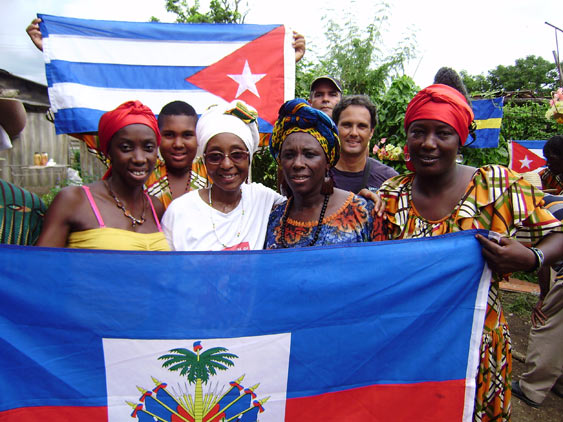
Gloria Rolando and
Reembarque cast with
Haitian and Cuban flags |
Haïtians in Cuba
Haïti has a strong presence in Cuba, dating back to the late 1790's after
the Haïtian revolution, when many French moved to Cuba and took their kidnapped Africans
with them. From this wave we get the Tumba Francesa and the Haïtian roots music in
Cuba. Haïtian tradition contains a strong strain of Dahomey and Congo, both of
which are present in western Cuba as well. Haïtian Rada is Cuban Arara, the Dahomey tradition.
During the early part of the 1900's, many Haïtiians were
brought in to cut sugar cane. In 1921 and again in 1937, when the market for
sugar fell, they were simply kicked out and sent home, such was the logic of
the neocolonial republic. This period is the subject of a documentary by
Cuban film maker Gloria Rolando,
Reembarque (Reshipment), for sale on this site.
More recently, Cuba is perhaps the only country to have welcomed so many
Haitians fleeing the persecution of the Haitian elites and their savage regimes. There are
reportedly over 300,000 recent arrivals in Cuba. And Creole, which is still spoken
by descendants of the earlier waves, is Cuba's second language, with a
Creole radio program in Havana. There are a number of
Haitian roots groups playing in Cuba, including Ban
Rrarra and Desandann.
Today, Cuba has several viable Haitian cultural organizations, including Bannzil Kreyol Kiba described in the
article below by Susana Hurlich.
The 12th annual Eva Gaspar Festival, 3/2011
El duodécimo festival Eva Gaspar, 3/2011 Eva Gaspar was a leader of
the Haitian community in Ciego de Avila. Cuba y Haití: Aún más próximas
Portal Cultural Principe, 03-04-2004
XXIV Caribbean
Festival, Feast of Fire, Santiago de Cuba, 7/04.
Dedicated to Haiti
See Cuba in Haiti for reports
on Cuban medical professionals and others in Haiti.
Artists
Ramón Haití
Eduardo
|
www.ecured.cu/Emilio_B%C3%A1rcenas_Pier Emilio Barcenas Pier
Haitian Organizations
Asociacion Haitiana-Guantánamo
www.facebook.com/ElPatioAcheLua
Ban Rrarra
Desandann
La Caridad de Ramón
Tumba Francesa La Caridad de Oriente
Haiti & Cuba: The Politics of US Immigration Policy 6/15/2023 Massachusetts
Peace Action: "The U.S. is experiencing great waves of migration to its borders.
There are multiple factors driving this migration, economic, climate-related,
and socio-political. But importantly, and not for the first time in its history,
the reception that these migrants receive as they try to enter the United States
is not the same for all and perhaps needs to be understood in both the U.S.
domestic and U.S. geopolitical context. There is a push-me-pull-me effect that
is, well, confusing. We want to understand what drives migration, and we also
want to understand why it is that different migrants from different countries
are treated differently when they get here."
La comunidad de haitianos y descendientes de Santiago de Cuba invita al V
Coloquio Nacional Emilio Barcenas Pier - La Haitianidad en Cuba 5/16/2023 Asociacion
Haitiana-Guantánamo
El Cabildo Congo y la Tumba Francesa La Caridad de Oriente en Santiago de Cuba. 1/2/2023 Oficina
del Conservador de Santiago de Cuba: "Los cabildos de nación y las tumbas
francesas en el Oriente de Cuba fueron escenarios del mestizaje cultural en los
tiempos de la esclavitud."
IV Coloquio Emilio Bárcenas Pier. La Haitianidad en Cuba. 11/17/2022 Asociacion
Haitiana-Guantánamo: "Transmitido en directo."
Festival Kiba Kreyòl 2022 5/11/2022 Asociacion
Haitiana-Guantánamo: "Bannzil Kreyòl Kiba es un proyecto socio-cultural dedicado
al estudio, conservación y difusión de la lengua kreyòl en Cuba. Fundado en
agosto de 1997, tiene una membresía de los cubanos, haitianos, descendientes de
haitianos y estudiantes en Cuba de los países que hablan kreyòl tales como
Martinica, Haití, Guadalupe, Santa Lucía, Guyana Francesa, las islas Seychelles,
Reunión, Rodríguez, Mauricio, Cabo Verde. El principal objetivo del Festival es
estimular el estudio y conservación de las lenguas criollas en Cuba y la región
del Caribe, y fomentar un intercambio de experiencias entre todas aquellas
personas interesadas e"n la lengua, la cultura y la identidad.
Viaje al centro de la periferia 11/11/2021 La
Joven Cuba: "Esa franja vodú crece silenciosamente en la periferia de la
capital, a través de redes de solidaridad y autogestión, al margen de normativas
político-administrativas que restringen cualquier posibilidad de desarrollo para
los migrantes. Aun así, estos desarrollan habilidades y resistencias que forman
parte de una agencia cultural, asistida por micropolíticas identitarias que les
permiten hacerse de un espacio físico y cultural propio."
“Al compás de la Tumba francesa” 1/17/2021 teleSUR: "En el siglo XX, la
migración de haitianos persistió y de 1902 a 1913 llegaron a Cuba alrededor de
190 000 haitianos y entre 1913 y 1930 un aproximado de 500 000. Casi todos se
asentaron en Guantánamo y Santiago de Cuba, y constituían el 40 % del total de
emigrantes que arribaron a las costas cubanas en ese período."
Destaca Tumba Francesa La Caridad de Oriente como tesoro vivo de la cultura
cubana 10/17/2018 TV Santiago: "La Sociedad de Tumba Francesa “La Caridad
de Oriente”, instituida el 24 de febrero de 1862, con 156 años, posee
importantes reconocimientos: la Bandera de la Ciudad Héroe, otorgada por la
Asamblea Municipal del Poder Popular, el Premio Nacional de la Cultura
Comunitaria 2000 y el Premio Memoria Viva 2004."
Music-Dance Group Enhances Haitian Culture in Cuba 8/22/2018 PL: "Ciego de
Avila: A group of 15 women descendants of Haitian immigrants based in this Cuban
province, is part of the music-dance group Famzetwal, a faithful defender of the
traditions and cultural roots of their ancestors."
Cuba & Haití share fraternal ties 2/6/2018 Granma: "The relations of
friendship and mutual respect shared by Cuba and Haiti were emphasized by Paul
Harry Guichard, chargé de affaires at the Haitian embassy in Havana, during an
interview with Granma. Guichard conveyed his people's thanks for the help
provided by Cuban doctors; literacy efforts using the "Yo, sí Puedo" method; and
the training of Haitian professionals, in particular doctors; also mentioning
the importance of several agreements signed by the two countries to promote
economic development in his homeland."
Grandes revoluciones caribeñas: Revolución haitiana y Revolución cubana 1/11/2018 UNEAC: “Se
dice la Revolución haitiana o la primera república negra en el mundo, pero no es
sólo eso. Hay que analizar que la clase dominante en América Latina siempre ha
sido blanca; incluso, siempre se ha querido separar el fenómeno haitiano del
latinoamericano. Sin embargo, luego del triunfo de la Revolución cubana y
gracias a los intelectuales cubanos es que se ha logrado enfatizar en que Haití
representa también el primer país latinoamericano independiente”.
Día del
haitiano en Cuba en la Casa de la Diversidad Cultural Camagüeyana 10/1/2017 AfroCubaWeb: por
Yoelxy Pilliner López - "Como cierre de la actividad, los pinos nuevos
disfrutaron del documental “Reembarque” de la realizadora Gloria Rolando, el
cual es un digno homenaje, desde el punto de vista audiovisual, a la herencia y
aporte haitiano a la cultura Cubana."
Aponte o la insurrección de los adelantados 3/14/2017 Granma: por Pedro de
la Hoz - "Aponte, que poseía instrucción militar y se inspiraba en los ejemplos
de los libertadores haitianos Toussaint L’Ouverture, Jean François y Jean
Jacques Dessalines, planeó asaltar los cuarteles de la capital. Reticencias de
algunos de los conspiradores y la delación de uno de ellos impidieron esas
acciones."
Proyectan Puerto Príncipe mío, del cubano Rigoberto López 1/31/2017 La
Ventana: "Puerto Príncipe mío, realizado en el año 2000, muestra las condiciones
de pobreza, crecimiento urbanístico descontrolado y estado de insalubridad que
impera en la capital haitiana, como consecuencia de décadas de dictadura y
gobiernos que han desatendido el campo y la ciudad, lo cual ha provocado enormes
migraciones internas de la población hacia Puerto Príncipe en búsqueda de alguna
forma de subsistencia económica."
La culture haïtienne à l’honneur à Cuba cette semaine 1/23/2017 Loop: "On
notera la participation de l'auteure et poète Nancy Morejón, qui récitera l'une
de ses œuvres consacrées à Fidel et ses liens avec le peuple haïtien, avec la
projection du documentaire « Puerto Príncipe Mio », produit par le réalisateur
Rigoberto Lopez, président du Caribbean Film Showcase."
Haitian roots in Cuba 1/20/2017 Granma: "Haitian culture week will take
place for the first time in Cuba from January 23-30. The seven day event is
being organized by the Havana City Historian’s Office in collaboration with the
Haitian Embassy on the island, and will be inaugurated in the capital’s Casa de
África."
Walker on Ferrer, 'Freedom's Mirror: Cuba and Haiti in the Age of Revolution' 11/1/2016 H
Net: "In Freedom’s Mirror, Ada Ferrer explores the tensions that underlay two
overlapping revolutions on neighboring Caribbean islands at the turn of the
nineteenth century: one, a struggle against slavery that culminated in the
foundation of the independent nation of Haiti, the other, a “sugar revolution”
that entrenched enslavement in Cuba. Ferrer traces the encounters between these
two societies on seemingly opposite paths."
Wifredo Lam: the unlikely comeback of the Cuban Picasso 8/31/2016 Telegraph,
UK: "Yet Lam’s attitude to this world of ancestral belief remained highly
ambivalent. His principle informant on Afro-Cuban culture wasn’t his godmother,
the Santeria priestess, but Lydia Cabrera, an upper-class, white anthropologist.
In Haiti, he attended a voodoo trance ceremony – not as a “local” who had
observed similar rituals as a child, but as part of a group of European
intellectuals, including Breton. “A lot of people have assumed we lived in a
Santeria environment,” says Eskil Lam. “Nothing could be further from the truth.
We had the most atheist upbringing you can imagine. My father lost his faith in
any kind of religion in the late Twenties and he never deviated from that.”"
Haiti - Education : 21 Haitian scholars depart for Cuba 8/23/2016 Haiti
Libre: "Monday at the National Palace in the framework of bilateral cooperation
Haiti-Cuba the de facto President Jocelerme Privert received 21 young scholars
(16 medical and 5 in law, engineering and agronomy) from different regions of
Haiti, that will leave the country on Tuesday August 23 for Cuba."
Special Feature - Screening & Discussion - Reembarque/Reshipment with Filmmaker
Gloria Rolando 6/8/2016 Caribbean Studies Association: in Port au Prince -
"Cuban leading documentary filmmaker Gloria Rolando will present and discuss her
recently released film “Reembarque/Reshipment” (58 min. In Spanish, with English
subtitles). “Reshipment” deals with a forgotten chapter in Cuban history when
thousands of Haitian laborers were forcefully repatriated (“reshipped”) to Haiti
in the 1930s when they were no longer needed in Cuban sugarcane fields or coffee
plantations. The film combines the voices of historians and Haitian witnesses
into a powerful tribute to the interwoven destinies of the peoples of Cuba and
Haiti. 1) Caribbean migrations, 2) Caribbean development and ideas for
sustainable economic integration 3) Caribbean labour and social movements 4)
Caribbean intellectual and socio-political movements."
Raúl receives provisional President of Haiti 6/6/2016 Cubadebate: "During
the meeting the two leaders reviewed the cooperation Cuba provides this sister
country in various sectors, and Raúl reiterated Cuba’s commitment to continue
supporting Haiti’s recovery and development. They emphasized the good condition
of bilateral relations, and discussed regional as well as international issues
of mutual interest."
Otorgan en Camagüey reconocimiento a grupo que rescata tradiciones haitianas 5/24/2016 Cibercuba: "El
galardón otorgado al Grupo Caijide, es, a decir de Yoelxy Pilliner López,
especialista de la Casa de la Diversidad Cultura de Camagüey, es un
reconocimiento a quienes ayudan a "distinguir valores que se han preservado
durante años y forman parte del acervo cultural de la población"."
Haitian and Creole Culture in Cuba 3/16/2016 Cuba Journal: "Afro-Cuban
filmmaker, Gloria Rolando made a tribute to the Haitians who migrated to Cuba in
her documentary film, Reshipment. It is a story of Haitian immigrants to Oriente
Provence, Cuba in the early 20th century and their forced repatriation after the
sugar market crashed. Rolando explains, “As poor backs and as foreigners, they
found themselves in a terrible situation.” Over time, the Haitian culture
developed a strong presence in Cuba. Creole, the second most spoken language in
Cuba after Spanish, has roots in the Haitians who came to Cuba. Despite
discrimination suffered by the Haitians, the Creole language, voodoo and other
musical and dance traditions remain in Cuba’s cultural milieu."
Homenaje en Cuba a Tumba Francesa Patrimonio de la Humanidad 12/27/2015 TV
Santiago: "Un homenaje a la Tumba Francesa La Caridad de Oriente rindieron en el
céntrico teatro Martí artistas de esta ciudad en ocasión de los 12 años como
Patrimonio Inmaterial de la Humanidad. Desde el jueves último y hasta hoy se dan
cita con el público bailarines y músicos del Ballet Folclórico de Oriente en un
espectáculo que incluye bailes populares con ejecuciones de ruedas de casino y
salsa, así como un ciclo de carnaval y un diálogo de tambores y conga
santiaguera."
“Kamahaití”, un ejemplo de simbiosis cultural 5/30/2015 Jiribilla: por
Yoelxy Pilliner López - "… las grandes oleadas de inmigración antillana en Cuba
se efectúan en las tres primeras décadas del siglo XX [2], siendo considerable
la entrada de haitianos en relación con la de jamaiquinos en calidad de
braceros, empleados como fuerza de trabajo por la Suggar Company y la United
Fruit Company en el sector azucarero y cafetalero, respectivamente, de la zona
oriental del país [3]. Surgen así las llamadas “haitianadas”, como se les
denominó despectivamente, a las oleadas que partían desde la costa sur de Haití
hacia la costa sudoriental de la isla. Este tráfico de braceros entre Haití y
Cuba estuvo controlado por contratistas haitianos que eran utilizados por las
compañías norteamericanas, quienes veían en estos hombres y mujeres mano de obra
barata y disponible a sus intereses."
Reembarque, una historia no contada 5/30/2015 Jiribilla: Entrevista con
Gloria Rolando
Afro-Cuban Filmmaker Brings Little-Known Caribbean History to Light 3/27/2015 Black
and Brown News: "During a four-month tour last fall, Rolando visited 19 U.S.
cities, screening and discussing Reshipment with audiences from all regions of
the country. Rolando found that people were thirsty for knowledge about the fate
of other African descendants in the Western hemisphere. “I cannot cover in a
one-hour documentary the whole complexity of the history of the Caribbean
countries, of our history as black people,” she says, but at least her films
give viewers “a little bit.” But Reshipment viewers get more than a glimpse into
the lives of the Haitians in Cuba. Through a mix of voices—including historians
and living descendants on both islands—and hauntingly beautiful music, the film
captures the complexity of the times."
Dark Specters and
Black Kingdoms: An interview with historian Ada Ferrer 2/6/2015 Public
Archive: "What we had not appreciated in the past is the extent to which the
Spanish army on the Saint-Domingue border was actually composed of troops and
officers from Cuba. So, in effect, you have men from Cuba dealing with Toussaint
Louverture, Jean François, Georges Biassou, and other leaders of the black
rebellion. One of the Cuban officers, the Marques de Casa Calvo, who would later
be the last Spanish governor of Louisiana, and who owned two sugar plantations
and an unknown number of slaves in Havana, actually started a business with the
rebels—buying sugar equipment from them and then sending it to Havana. He became
the godfather of Jean-François and even flirted and danced with his wife."
Cuba and Haiti Plan to Release Joint Edition of Books in Creole 12/22/2014 Cubarte: "Literary
authorities from Cuba and Haiti agreed to release a joint edition of new books
in Creole, as part of the initiatives to protect the dialect and bring the
nations together. The agreement was a topic of interest of the recently
concluded Haitiï's International Book Fair, where Cuba was guest of honor, and
showed signs of progress even though there is still lots to do to be
consolidated. Zuleica Romay, president of the Cuban Book Institute, told Granma
different plans are being developed along with Haiti's National Book Directorate
to encourage children to read in Creole."
Meet Gloria Rolando, on tour with her new film ‘Reembarque’ on Haitian
farmworkers in Cuba before the Revolution 11/7/2014 SF Bay View: "The title
of this documentary is “Reembarque,” and it’s dedicated to the presence of the
Haitians in Cuba who arrived at the beginning of the 20th century. They arrived
in Cuba because it was a big business to bring a cheap labor force for Cuban
industry, and the Haitians were producing for the big Cuban industries at that
time. They suffered a lot of exploitation and discrimination, but in time they
were told we don’t need them anymore. Because of the crisis of the Cuban economy
after the first World War, they decided that they don’t need them and so they
sent them back to Haiti. It’s a chapter in human history that is not really well
known, but it’s in the memory of many Haitians who were children at that time
and they don’t know what happened with their relatives. So it’s time to remember
the chapter and to interview the people before we lose this kind of memory of
the exploitation and discrimination against people who migrate to another
country. It’s a topic that’s important to us. I’m talking about the past and
also about the present."
Forgotten
history: Gloria Rolando screens film Oct. 13 9/24/2014 Washington
University in St Louis: "In the early 20th century, thousands of Haitian
laborers worked the coffee plantations and sugarcane fields of Cuba, influencing
the island’s music, language and culture. But when the market crashed, in the
1930s, many were expelled — sent back across the Windward Passage in the
Caribbean Sea like so many damaged goods. In “Reembarque/Reshipment” (2014),
Cuban filmmaker Gloria Rolando revisits this forgotten chapter, recounting both
the memories of Haitian families and the discrimination suffered by their Cuban
descendants. The result is part Caribbean social history and part homage to the
dreams and hardships of the immigrant experience."
Reembarque hacia los orígenes 9/11/2014 Granma: "Danzas, cantos, estampados
sobre todo en la interpretación musical del trovador camagüeyano descendiente de
haitiano Ebenezer Semé —quien asistió a la prémiere en el cine capitalino 23 y
12— y el coro Dessandan, de Santiago de Cuba, y un toque mágico también conviven
en este filme, que no pierde de vista ningún detalle de la idiosincrasia de sus
portadores. En el estreno la propia creadora afirmó que “nosotros los que
vivimos en la zona occidental no tenemos conciencia de lo importante que es la
contribución del haitiano, del jamaicano, del barbadense, no tenemos conciencia
de cuán caribeños somos”."
September, a month for documentaries, between homages and traditions 9/7/2014 OnCuba: "Producer
Gloria Rolando dealt with the topic of Cuban inheritances and traditions
enriched by African immigrants. This successful producer of documentaries is one
of the most active filmmakers in the field of documentaries, and has focused her
work on the traditions of black Cuban communities. Her powerful speech is in
accordance with the dignity of the characters she portraits in her pieces. This
month she brings two documentaries Reembarque and Pasajes del corazón y la
memoria. The first one lasts 58 minutes and includes the several prestigious
historians whose researches add up to the memories of Haitians and their
descendants in Cuba. The oldest still recall their families were victims of
re-embarking. Therefore, she decided to pay this well-deserved homage to
anonymous heroes that intertwined an important passage between two Caribbean
peoples: Cuba and Haiti."
Estrenarán próxima semana filme documental dedicado a inmigración haitiana a
Cuba 9/5/2014 Radio Cadena Agramonte, Camaguey: "El filme documental
“Reembarque” de la realizadora Gloria Rolando Casamayor tendrá su premier el
próximo día 10 en la sala 23 y 12 de esta capital, y al día siguiente pasará al
circuito nacional de estrenos cinematográficos… La directora incorpora las
opiniones de prestigiosos historiadores de ambas naciones que junto a los
recuerdos de haitianos de aquí y de allá, y de sus descendientes, van
conformando la historia del reembarque hacia su tierra de origen, que les fue
impuesto a muchos haitianos en Cuba en el año 1937 por una decisión del entonces
presidente Ramón Grau San Martín, y que provocó la separación de muchas
familias; es una historia de soledad y desarraigo familiar pero a la vez la
cinta muestra la permanencia de la cultura haitiana en la Isla hasta nuestros
días. “Reembarque” logra, a través de la fotografía de Oscar M. Valdés y de la
banda sonora, de Juan Demósthene, conformada por composiciones realizadas para
la cinta por Lucía Huergo, interpretaciones del grupo vocal Desandann y otras
piezas, reflejar la poesía implícita en la cultura haitiana. Merece destacar el
trabajo de edición desarrollado por Fermín Domínguez y el fuerte ritmo de la
cinta, que a pesar de tratar un tema histórico mantiene la atención del
espectador con la utilización de la música y la superposición de gran variedad
de planos que enriquecen la obra desde el punto de vista visual."
En Cuba documental dedicado a la inmigración haitiana 9/5/2014 Radio
Reloj: "Reembarque, filme documental de la realizadora Gloria Rolando Casamayor
tendrá su premier el próximo día 10 de septiembre en la sala 23 y 12 de la
capital cubana. La nueva producciónn del Instituto Cubano del Arte e Industria
Cinematográficos (ICAIC) es un homenaje al pueblo de Haití y a las familias
cubanas descendientes del país caribeño."
Estrenarán documental Reembarque sobre migración haitiana a Cuba 9/3/2014 Radio
CMBQ: "La más reciente producción documental de la realizadora Gloria Rolando,
Reembarque, que indaga sobre la migración haitiana hacia Cuba a principios del
siglo pasado, será estrenada desde el próximo 11 de septiembre en salas cubanas
de cine. Haití es el país del Caribe que más ha trabajado la cinematografía
cubana, por lo que Reembarque vuelve sobre una huella tan fuerte y presente como
es el tema de la migración de esta región, específicamente la historia de los
braceros antillanos, expresó Rolando."
Presencia haitiana en Cuba en documental Reembarque 9/3/2014 Radio Habana
Cuba: "El filme recrea las vivencias de muchos haitianos que dejaron su país
para llegar a Cuba y trabajar en centrales azucareros como mano de obra barata y
la repatriación que sufrieron por los gobiernos republicanos en la mayor isla de
las Antillas. Gloria Rolando, con 38 años trabajando el tema, dijo a la prensa
que durante el período que aborda (de 1915 a 1937), muchas familias cubanas
brindaron su apoyo a los perseguidos y los acogieron en sus casas, por lo que se
forjó una relación que perdura hasta hoy con la presencia de la cultura haitiana
en Cuba."
Caidije 7/18/2014 Casas de Cultura: "Perteneciente a la Comunidad de
inmigrantes del Caribe franco-hablante y sus descendientes que conservan su
grupo músico-danzario tradicional. Ubicado en el poblado de Minas en la
provincia de Camagüey. Fundado en 1926, expresa elementos culturales de la
segunda inmigración haitiana, llegada a Cuba en el primer cuarto de siglo XX.
Sus presentaciones artísticas se destacan por su reconocimiento en la comunidad
como parte de su legado cultural. Cuenta con 25 integrantes y dentro de su
repertorio cuentan con géneros como: el merengue, mazun, nagó, Rey gagá y
Ceremonia de Ogún."
Nicolás Guillén un viaje a la sociocultura cubana 6/21/2014 Tiempo 21: "La
representante de la Cultura Haitiana en Cuba, Maritza Donatien Texidor, resaltó
que los estudios de las culturas africanas fueron novedades que impulsaron las
vanguardias culturales de esa época, como el poeta Nicolás Guillén, quien
encontró un espacio prolífero para su prosa permeada del folklor africano, con
una cultura en constante transculturación."
Destacan labor de Cuba por los refugiados 6/20/2014 Radio Habana: "Entre
1991 y 1994 el arribo a la zona oriental de Cuba de cuatro mil 500 haitianos,
luego del golpe militar que depuso al presidente Jean Bertrand Aristide, fue
también un hecho significativo por el operativo desplegado para la protección y
asistencia humanitaria", precisó."
Arte en Matanzas: un puente entre Cuba y Haití 6/16/2014 Girón: "Un posible
vínculo para la cooperación entre la provincia cubana de Matanzas y Haití quedó
abierto con la inauguración del XV Taller Provincial de Artesanía Tradicional y
Utilitaria, que anualmente organiza la Asociación Cubana de Artesanos y Artistas
de Cuba (ACAA) y que en esta ocasión contó con la presencia del cónsul del
hermano país."
Vocal Desandann: from Cuba, Ambassadors of the Haitian culture 6/5/2014 Cuba
Contemporánea: "The recent 18th International trade fair Cubadisco 2014 and the
award in the category of Vocal music to its first phonogram produced in Cuba
under the auspices of the Colibrí record label Anfom: Vocal Group Desandann (in
creole language Anfom means "shaped" and Desandann "descendants"), were the
pretext to learn about this distinguished institution of the province of
Camaguey. Descendants all of Haitians, from a first to a fourth generation, as a
family gets together to rehearse in the House of Emilia Díaz Chávez, Director of
that group, in the midst of celebrations this year anniversary 20 of its
conformation."
Raúl congratulates renowned dance companies 5/23/2014 Granma: "In messages
read by Minister of Culure Julián González during the gala awards ceremony in
Santiago de Cuba’s Teatro Martí, Raúl praised the commitment of these two
companies to defending the country’s African roots, as the first two folkloric
dance and music companies which emerged after the triumph of the Revolution in
1959. “You have made an effort to authentically preserve Afro-Cuban and
Caribbean dance traditions for present and future generations. At the same time,
you have demonstrated your deep patriotic and revolutionary commitment,” Raúl
indicated in his message to the Folclórico de Oriente."
55 AÑOS DEL MOVIMIENTO FOLKLÓRICO CUBANO 5/23/2014 UNEAC: “Seguiremos
danzando por Cuba”, dijo Idalberto Bandera, director del Ballet Folklórico
Cutumba al recibir este jueves de manos del Ministro de Cultura de Cuba Julián
Gonzáles Toledo, el mensajes enviado por el presidente cubano Raúl Castro Ruz a
su compañía y a los bailarines del Ballet Folklórico Oriente, quienes celebran
los 55 años del movimiento folklórico profesional en Cuba."
Envía Raúl mensajes de felicitación al Ballet Folclórico de Oriente y al Ballet
Folclórico Cutumba 5/22/2014 Granma: "El General de Ejército Raúl Castro
Ruz, Primer Secretario del Comité Central del Partido y Presidente de los
Consejos de Estado y de Ministros, envió sendas felicitaciones al Ballet
Folclórico de Oriente y al Ballet Folclórico Cutumba, en ocasión del
aniversario 55 de la creación de estas reconocidas agrupaciones danzarias. Dadas
a conocer por el ministro de Cultura, Julián González, en la gala artística
dedicada a la celebración en el Teatro Martí, Raúl resaltó en sus misivas la
consagración a la defensa de nuestras raíces de origen africano, de estas
primeras agrupaciones de música y danza folclórica surgidas tras el triunfo
revolucionario en 1959. stedes se han esforzado por preservar rigurosamente las
tradiciones danzarias afrocubanas y caribeñas para las presentes y futuras
generaciones. Al propio tiempo han demostrado un hondo compromiso patriótico y
revolucionario”, señaló en la enviada a los integrantes del Folclórico de
Oriente. Por su parte, al dirigirse al colectivo del Cutumba expresó: “Ustedes
han sido portadores de un auténtico mensaje de cubanía en múltiples escenarios
de nuestro país y del mundo. En los propios Estados Unidos han librado
importantes batallas contra el bloqueo a través del arte, de sus convicciones y
posiciones consecuentes”."
Embajador de Haití reconoce solidaridad de Cuba 2/5/2014 Cubadebate
Naggó 1/28/2014 Casas de Cultura: "El grupo Nagó surge a partir de las
primeras organizaciones danzarias creadas por los inmigrantes haitianos donde
por un tiempo simplemente fue un grupo para festejar a la manera de la
celebraciones de Haití. Estas reuniones tenían sus momentos cumbres en la Semana
Santa, donde el grupo salía a visitar otros barrios de asentamientos haitianos
que festejaban a la par. Sus puntos de congregación eran guardarrayas, bateyes,
4 caminos y otros lugares, con un propósito común de cantar y bailar a través de
los saberes y arraigos traídos por sus inmigrantes."
Pilón del Cauto 1/22/2014 Casas de Cultura: "Agrupación músico danzaria de
origen franco haitiano (Vodú), la cual tuvo su origen el 23 de diciembre 1983,
como resultado de un trabajo de rescate y revitalización llevado a cabo por un
grupo de investigadores de la Casa del Caribe y la Casa de la Cultura Ángel
Peralta Téllez. Residen en la Comunidad “Pilón del Cauto”, en Dos Palmas,
municipio de Palma Soriano. En 1912 durante el gobierno de José Miguel Gómez las
inversiones imperialistas se realizaron en mayor parte en el sector azucarero en
Camaguey y Oriente, por lo que es necesario incrementar la mano de obra de obra
barata, ese mismo año comienza la inmigración de braceros antillanos y chinos en
busca de trabajo, existiendo en la Isla Colonias franceses de café
principalmente en el Oriente del país."
Haitian Official Stresses Cuba's Regional Integration Role 1/3/2014 Periodico
26: "Under Cuba's presidency, the Community established relations with the BRICS
group of countries, which includes Brazil, Russia, India, China and South
Africa. Cuba is the door to this region and the bridge between the Caribbean and
Latin America, said the Haitian official, who explained that the island has been
the chair of the organization as part of a troika that also includes Chile and
Costa Rica."
'Reembarque', nuevo documental de la cineasta cubana Gloria Rolando 10/2/2013 Cuba
Informacion: "La directora de documentales Gloria Rolando rueda actualmente en
Haití las locaciones finales de su documental Reembarque que trata sobre la
migración de esa isla caribeña hacia Cuba en los años desde 1915 y hasta 1937.
La Rolando dijo que antes de ir a Haití visitó la Sierra Maestra, Santiago de
Cuba, Holguín y Camagüey donde existieron asentamientos haitianos quienes en la
época de la neocolonia trabajaron en compañías norteamericanas y con colonos
azucareros como mano de obra barata."
'Reembarque', nuevo documental de la cineasta cubana Gloria Rolando 10/2/2013 Cubainformacion: "La
Rolando dijo que antes de ir a Haití visitó la Sierra Maestra, Santiago de Cuba,
Holguín y Camagüey donde existieron asentamientos haitianos quienes en la época
de la neocolonia trabajaron en compañías norteamericanas y con colonos
azucareros como mano de obra barata. “De ellos nos quedaron bailes, la música,
pero quiero indagar en la separación familiar acaecida en 1937 cuando fueron
familias enteras separadas y muchos enviados de retorno a Haití” agregó la
cineasta, quien tiene un largo camino recorrido en documentales que tratan sobre
las migraciones hacia la Isla como fue la francesa luego de la revolución
haitiana."
Saint-Domingue (Haití) - Hanau (Alemania) - Angerona (Cuba) 9/1/2013 Kreol
Deutchland
Bonito Patuá 7/24/2013 Casas de Cultura: "Agrupación de estirpe del Caribe
insular francófona, Vodú, fundada el 30 de Noviembre del año 1961 en el poblado
de Mamanantuabo en Esmeralda, luego se trasladaron al municipio Camagüey en el
Reparto Bella-Vista, donde ejecutaban y celebraban sus diversas manifestaciones
identitarias, comenzando el proceso de continuidad y transmisión de los
inmigrantes a sus familiares y descendientes haitianos a través de sus hábitos,
costumbres y tradiciones culturales. Ha portado a diferentes generaciones sus
valores culturales: bailes, danzas, arte culinario, artesanal, canciones,
toques, vestuarios, entre otros.Se dedican a representar sus sellos y arraigos
los fines de semanas, practicando sus preceptos; religiones, bailes, toques y
hasta algunas comidas y bebidas afrodisíacas en tardes del Vodú."
111-year-old Haitian admires rooting of his culture in Minas 4/17/2013 Adelante: "With
a beautiful white guayabera (traditional Cuban shirt), the elder was present
along with Tomás, his tenth son, at the activities that privileged the musical,
dance, food and drinks demonstrations from his original nation. This man with
enviable health who still tastes the ¨aguardiente¨ (Cuban highly alcoholic
beverage), came up to the obelisk of the little town of Cortadera - ten
kilometers from Minas - to produce homage to the Haitians massacred there in
1933, for rural guards and of the ancient central Senate."
The Creole Choir Of Cuba: Reviving Caribbean History In 'Santiman' 1/10/2013 NPR: "It
might come as a surprise to learn that people of Haitian descent are the largest
ethnic minority in Cuba. But that's the history behind The Creole Choir of Cuba,
a vocal and percussion ensemble that performs songs about history, faith and
social change in the Caribbean. The choir consists of six women and four men,
who sing in tribute to the migrations of their ancestors. On their new album,
Santiman, the choir delves into the intertwined histories of Cuba and
neighboring Haiti."
Will Haitian President Michel Martelly's visit become another missed
opportunity? 12/1/2012 AfroCubaWeb: "Cuba on the other hand, cannot in good
conscience or with moral convictions hold on to millions of acres of fallow,
untilled land, knowing its use can improve the lives of tens of thousands of
Haitians, stabilize Cuba food security and restore the viability of our sugar,
coffee and cocoa industry, presently on life support. Cuba can erase its debt of
gratitude with Haiti and other Caribbean islands, by implementing an orderly
migrant workers law, by which tens of thousands of families could enter and work
in the country under clear cut regulations, which forbids all unsocial behavior.
Prioritizing the purchase of products and produce from our neighboring islands
through the development of coastline shipping lines and an increase in human
interactions is a past due imperative."
The Fertile Crescent: Haiti, Cuba and Louisiana 11/25/2012 Afropop
Worldwide
Haiti in
Cuba - La Caridad de Ramón 7/28/2012 YouTube: ""La Caridad" is the folklore
ensemble of a group of people of Haitian descendance living in a village called
Ramón. It is located in a zone of coffee cultivation within the municipality of
Palma Soriana. The hamlet lies above the banks of the Cauto river, which flows
from the Sierra Maestre in the eastern part of Cuba. Like the groups "Gagá de
Thompsón" and "Gagá de Barranca", "La Caridad" is a "grupo portador" - a
safekeeper of Haitian popular traditions in the Cuban context. The group was
founded by the late Tomacito Poll in 1983, and several family members still
belong to La Caridad (His son Pochólo -Victor- started another roots-band called
"Ibó"). All these bands have links to the Casa del Caribe in Santiago de Cuba.
Fundación Interchange and Revista Batey are making an effort to uncover the
history of Haitian inmigration and processes of cultural transformation in Cuba.
The idea is to publish a book with dvd next year."
ANTÉNOR FIRMIN: UN HAITIANO EXTRAORDINARIO 6/25/2012 UNEAC: "La comisión de
racialidad Clotilde Agüero en la sede del comité provincial de la UNEAC propuso
un interesante acercamiento a la vida y obra del destacado sociólogo y
periodista haitiano Anténor Firmin…"
Vodú Chic:
Haitian Religion and the Folkloric Imaginary in Socialist Cuba 6/1/2012 New
West Indian Guide: "Today however, the continuation of Haitian customs is no
longer linked with isolation, but exactly the opposite: performance troupes,
heritage festivals, art exhibitions, the circulation of religious specialists,
collaborations with research centers and academia, endorsement by music
promoters, and the tourism industry. In socialist Cuba, “folklore” is a valuable
resource. Although some Cubans of Haitian descent hide their affiliation, others
proudly claim their heritage and this inclination is growing. Policy makers and
culture brokers both within the socialist state and internationally have begun
to notice, valorize, and promote the arts and traditions of this ethnic
subgroup."
From Haiti to Cuba and Back: Haitians’ Experiences of Migration, Labor, and
Return, 1900-1940 4/4/2012 University of Pittsburgh: "I show the ways that
Haitian men and women navigated the harsh working and living conditions in both
Haiti and Cuba by creating and maintaining kinship, commercial, religious, and
social networks in sugar plantations, coffee farms, and urban spaces. These
links cut across national lines and decisively shaped the conditions under which
they moved, labored, and lived in both countries. Reconstructing Haitians’
interactions with other workers outside the gazes of company and state
illustrates how those institutions functioned on the ground, questions the
extent to which national-level racial ideologies determined local social
relationships, and demonstrates how workers’ actions shaped the implementation
of migration and trade policies."
An Unorthodox Look
at Haiti & Cuba (Part Two) 7/10/2011 Havana Times: "However there are
reports by independent bloggers who were there that the people are
self-organized, as happened in the U.S. when Katrina hit. They set up camps and
spontaneous rescue brigades. And above all there was much caring, unlike the
stereotype that the mass media created to impose regimes of law and order, as
happened later, but not because of the people but because of the way aid is
delivered by the U.S. troops, for example. This teaches us a lot about how
racism and authoritarianism use the same logic of contempt toward outside
protagonists. That is the argument of authoritarianism: there are barbarian
people who must be dealt with by force and strength because if not, they won’t
fit in the mold. Sexism works exactly the same. That was what was shown in a
wonderful and terrible way after earthquakes in Haiti."
The Caribbean Diaspora from the African Diaspora. The Cuban Chapter 5/30/2011 Cuba
Now: by Graciela Chailloux - "The 1929 world crisis represented the end of a
frenetic sugar growth in the Island that lost its support in the international
market. Unemployment took over the national life, as for Cubans as for
foreigners, so the resource at hand was the massive deportation of Haitians and
English-speaking West Indians, and the promulgation in 1934 of a law that
guaranteed employment in every company to 50% of the Cubans."
The Creole Choir of Cuba – UK tour – January/ February 2011 1/4/2011 Timba
Geek: "Prepare to be blown away by The Creole Choir of Cuba – the passionate
melodies, wild harmonies and richly textured arrangements of ten inspiring
vocalists. This is something new from Cuba, the most original vocal sound to
come out of the country in a long while. Desandann, the Choir’s Cuban name,
literally means ‘descendents’ and with the songs on their album ‘Tande-La’
(which translates to ‘listen’) they tell the stories of their Haitian ancestors
who were brought to Cuba to work in near slave conditions in the sugar and
coffee plantations."
La Casa del Caribe felicita a la Tumba Francesa Pompadour Santa Catalina de
Ricci por los 105 años de su fundación. 1/2/2011 Casa del Caribe: "Una de
las más genuinas expresiones de la huella franco haitiana en nuestro país es,
sin asomo de duda, la Tumba Francesa. Al verles actuar resulta siempre motivador
cómo una forma de expresión que nació de la necesidad de una burla de los
esclavos hacia sus amos, ha devenido en forma de perpetuar algunos de los
valores de nuestra cultura popular tradicional."
The Impact of Haiti on Afro-Cuban Racial Consciousness: Black Nationalism and
Mobilization 12/18/2010 El mundo es Robert: "While whites invoked Haiti to
provoke fear, justify harsher slave codes in Cuba and weaken nationalism, free
and enslaved people of African descent used it to positively assert racial
pride, unity, and defend abolition throughout the Americas. Thus, Haiti as a
symbol and historical agent promoted Afro-Cuban racial consciousness and shaped
black perspectives on freedom from the early 19th century to the early 20th
century, culminating in the 1912 Oriente province uprising."
Caribbean Film Traveling Festival Holds Avilanian Documentary 12/16/2010 Invasor: "An
Avilanian documentary, Una misma raza (the same race), will be on at the Third
Caribbean Film Traveling Festival, whose itinerary will include countries of our
geographical area like Jamaica, Bahamas, Barbados, Grenada, Martinique, Colombia
and Venezuela. The Audio-Visual sample by Avilanian filmmaker Jorge Luis Neyra,
selected for the festival last February, devotes its 20 minutes to deal with the
Eva Gaspar National Afro Caribbean Festival, sponsored by the Joseíto Fernández
Culture House in the Primero de Enero municipality of Ciego de Avila. Every year
the event is held to revitalize and promote Haitian dance and music and its
legacy to the Cuban culture. In addition, he provides a biographical approach to
the figure of Eva Gaspar, the Haitian leader of of the Hatian community in the
Primero de Enero, and the Nagó music and dance company, that was granted the
National Community Culture Prize."
Querido Ayiti, Haití cheri 5/29/2010 Boletin Musica: pagina 92: "Ayiti
cheri, voz creóle que versa en español Querido Haití, es el nombre del proyecto
que, encauzado por la Casa de las Américas, persigue potenciar, divulgar y
promover el patrimonio cultural de ese país desde sus estrechas relaciones con
Cuba. De esta forma, artistas e intelectuales cubanos y haitianos devienen
copartícipes del largo proceso de recuperación que demanda la hermana nación
caribeña, víctima del terremoto ocurrido el pasado 12 de enero."
A Vodú Party for the
Gods 4/10/2010 EthnoCuba: By Grete Viddal - "I went up a mountain, near
Santiago, to houngan Pablo’s party for the gods. He lives in a place called
Pilon del Cauto, near the river Cauto, about two or three (depending on road
conditions) hours from Santiago, accessible by jeep, truck, or legs. Guests
arrived, some carrying a borrowed mattress to spend the night…"
Médicos cubanos, entre los primeros que asistieron a los haitianos 1/14/2010 CubaDebate
Segundas Jornadas de Cultura de Haití en homenaje a Martha Jean-Claude, 2009 12/13/2009 AfroCubaWeb: por
Manuel Rivero Glean - "Municipio Plaza de la Revolución, en la sede del Proyecto
Comunitario "Rincón de los Milagros", en la calle Tulipán s/n, entre Marino y
Estancia, Nuevo Vedado, C. de La Habana, entre el viernes 11 y el domingo 13 de
diciembre de 2009. El Proyecto Comunitario Rincón de los Milagros, en
coordinación con la Dirección Municipal de Cultura, el Consejo Popular de Plaza,
la Fundación Martha Jean-Claude, la Comunidad de Haitianos de la Asociación del
Caribe y los vecinos de la comunidad, le invitan a participar en esta actividad
cultural, como protagonista y espectador."
IV Encuentro de la Cultura Franco-Haitiana en Barrancas 11/30/2009 Case Del
Caribe: "La idea de reunir a las agrupaciones de origen haitiano en sus propias
comunidades en una suerte de Festival fue apoyada desde sus inicios hace ocho
años por la Casa del Caribe y Joel James, su fundador. Hoy en el IV Encuentro de
lo más representativo de la cultura franco-haitiana el Director de la Casa del
Caribe, Orlando Vergés considera que estas acciones deben tener más respaldo
institucional y gubernamental para que se mantenga la tradición: “En realidad es
un desafío que los grupos de orígen haitiano se hayan reunido en tres lugares
importantes del país, en esta comunidad de Barrancas, empezó por aquí, en
Violeta, Ciego de Ávila; y en Cueto para expresar su cultura. Te digo que es un
desafío porque en las circunstancias actuales es difícil, aún cuando tienes
todos los recursos, reunir a tanta gente. Y ellos lo hacen con tanto amor, con
tanto sacrificio, contando con las autoridades locales, y lo hacen bien."
Realizarán Festival de la cultura franco-haitiana 11/17/2009 Granma: "Los
elementos más autóctonos de las raíces franco-haitianas en la cultura cubana
serán expuestos en el IV Festival dedicado a esta temática, del 20 al 22
próximos. El poblado de Barrancas del municipio santiaguero de Palma Soriano
acogerá esta fiesta musical-danzaria, donde se mostrarán las manifestaciones
vivas de la haitianidad en Cuba: el creole como forma de comunicación
intrafamiliar, los instrumentos tradicionales y su presencia histórica y
cultural. La práctica del Gagá, celebración litúrgica, es el pretexto para
reverenciar la oralidad, los ritos mágico-religiosos, la cultura culinaria y los
bailes a ritmo de tambor -merengue, congó e Ibó- que legaron al ajiaco cultural
cubano los inmigrantes de la vecina isla del Caribe."
Cuba - Information related to Intangible Cultural Heritage - Proclamation 2003:
"La Tumba Francesa" 7/9/2009 UNESCO: published 5/07 - "The dance, song and
drumming style known as Tumba Francesa (French Drum) was brought to Cuba by
Haitian slaves who were resettled in the island’s eastern regions following the
unrest in Haiti during the 1790s. It embodies one of the oldest and most
tangible links to the Afro-Haitian heritage of Cuba’s Oriente province and
developed from an eighteenth- century fusion of music from Dahomey in West
Africa and traditional French dances. After Cuba’s abolition of slavery in 1886
and the resulting migration of former slaves to urban areas in search of work,
Tumba Francesa societies emerged in several cities."
Despite Cuba embargo, relief finds a way 7/6/2009 Miami Herald: "This does
not concern Dr. Alberto Jones, a Cuban who arrived in Miami during the Mariel
boatlift and has been involved with the convoys each year since 1999. ''I'm not
afraid to go to jail,'' he said Sunday night at Ham & Eggery restaurant in North
Miami Beach, where the truck is parked. Jones' activities mirror those of a
growing number of Cuban Americans who question the embargo, which was imposed
almost 50 years ago to apply economic pressure on the Cuban dictatorship in the
hope of speeding its downfall. As Jones walked around the truck, which is set to
join others in Texas later this month, he said American treatment of Cuba
disgusts him. ''If you don't see the suffering, you don't feel it,'' he said.
``I saw kids starving and I changed my point of view. I do this [work] in Haiti,
Jamaica, the Dominican Republic -- and Cuba. What's the difference?''"
Haiti in Cuba:
Vodou, Racism & Domination 6/8/2009 Havana Times: "The Haitians brought the
Vodou religion to Cuba. The great anthropologist from Santiago de Cuba, Joel
James, who studied that culture, says that hundreds of Haitian workers were
massacred and literally thrown into the sea during the period prior to 1959. A
strong xenophobia existed against them in Cuba, as well as anti-black racism,
leading to events that could be characterized as genocide or ethnocide. They
were the last card in that deck, however. The revolutionary triumph of 1959 put
an end to such occurrences, although a certain degree of prejudice against the
Vodou religion remained. This prejudice still exists, even among some of those
who practice other belief systems of African origin."
Homenaje hoy en Cuba a Martha Jean Claude 3/21/2009 PL: "El aniversario 90
del natalicio de la destacada cantante haitiana Martha Jean Claude será
conmemorado hoy aquí con una evocación artística a la grandeza de quien fuera
genuino exponente del folklore caribeño El programa, organizado por la fundación
que lleva su nombre y la embajada de Haití en Cuba, tendrá como sede la Casa de
la Amistad e incluye las actuaciones del cantante Pablo Santamaría, la Orquesta
Gloria Matancera y los hermanos Santos como pareja de baile. También brindarán
su arte la violinista Mabel Serrano, nieta de Martha Jean Claude y una coral
infantil que interpretará en creóle canciones de la afamada cantante. El
embajador de Haití en Cuba tendrá a su cargo las palabras de apertura y luego un
representante de la comunidad de esa nación en la Mayor de las Antillas
destacará la fraterna relación de la artista con el pueblo cubano, que le acogió
como una más de sus hijas. En el homenaje hará uso de la palabra Richard Mirabal
Jean Claude, hijo y presidente de la fundación y se presentará el libro
Haití-Cuba, hechos más relevantes, de Diana Cantón, secretaria de la embajada
haitiana."
Haitian Medical Students in Cuba 11/28/2008 MEDICC: "Haitian medical
students in Cuba—number some 700—study at the Santiago de Cuba “Caribbean
campus” of the Latin American Medical School where their academic record is
outstanding."
USAID, key weapon in dirty war on Latin America 9/23/2008 Monthly
Review: "In Haiti, the USAID is among a number of U.S. agencies that organized,
directed and funded Haitian political organizations to provoke the kidnapping
and grotesque eviction of President Jean-Bertrand Aristide. In Venezuela, the
agency was scandalously active in backing and financing the sectors responsible
for the coup of April 11, 2002. The uninterrupted squandering of the funds of
USAID and its subsidiaries with coup-inspired operations is already in excess of
$15 million, via the funding of hundreds of groups and mini-groups aligned with
the U.S. embassy. In Bolivia, the USAID program is focused on the country's
Balkanization and the funding of violent activities against the authority of the
president. A few weeks ago, various farmers' federations and five municipalities
in the Cochabamba region expelled agents from this organization after exposing
their involvement in plotting a coup d'état."
Letter from
Assata on her 60th Birthday Celebration 3/27/2008 HOA: "I am 60 years old
and I am proud to be one of those people who stood up against the ruthless,
evil, imperialist policies of the U.S. government. In my lifetime I have opposed
the war against the Vietnamese people, the illegal contras – war in Nicaragua,
the illegal coup in Chile, the invasion of Haiti and of Granada, and every other
illegal, immoral and genocidal war the U.S. government has ever waged. I have
never been a criminal and I never will be one. I am 60 years old and in spite of
government repression, in spite of the media’s lies and distortions, in spite of
the U.S, government’s COINTELPRO Program to criminalize and demonize political
opponents, I feel proud to count myself as someone who believes in peace and
believes in freedom. I am proud to have been a member of the Black Panther Party
although the U.S. government continues try to distort history and continues to
persecute ex-members of the Black Panther Party. Just recently, the U.S.
government has indicted and arrested 8 ex-Black Panthers in a case that was
dismissed 30 years ago. The case was dismissed some 30 years ago when it became
obvious that the most vicious forms of extreme torture were used to extract
false confessions from some of the so-called defendants."
Rosa Parks would be proud 3/11/2007 Uncommon Sense: "American civil rights
icon Rosa Parks didn't take any grief from those who would repress her. And
neither does the Cuban human rights activist and independent librarian Juan
Bermúdez Toranzo. Journalist Roberto Santana Rodríguez, in a story posted at
Payo Libre, reports that the 40-year-old Bermúdez — who runs the "Rosa Parks
Independent Library" — was arrested as he left the the U.S. Interest Section in
Havana on March 5." [Uncommon Sense is the blog of Marc Masferrer, nephew of El
Tigre, who spent time in US Federal Penitentiary for attempting to seize Haiti
as a base for anti-Castro activities.]
Actuará en Haití el trío cubano Ledema 7/28/2006 Radio Progreso: "El trío
Ledema y el percusionista Alexis Velázquez, pertenecientes al catalogo artístico
de la Promotora cubana Musical Ignacio Piñeiro, actuarán a partir del 1 de
agosto y durante tres meses en cinco ciudades de Haití, para los médicos y
maestros cubanos que brindan su colaboración en ese país caribeño. Bajo la
dirección del cantante y guitarrista Erdén Hernández Pérez, la agrupación
promoverá su más reciente CD ¨ Volveré a ser un caminante¨, que incluye
populares piezas como La Culebra, de Obdulio Morales, Siboney, de Ernesto
Lecuona, Sublime Ilusión, de Salvador Adams y la que da título al fonograma del
propio Hernández. Auspiciado por la Fundación de la cantante haitiana Marta Jean
Claude (1919-2001), las presentaciones de los artistas serán por primera vez en
Puerto Príncipe, Montrouis, Petion ville, Petit Goave y Port de Paix. Los
integrantes de Ledema anteriormente han dejado su huella musical en países del
continente africano, europeo y América Latina. Ledema, fundado en 1982, es un
apocope de Leonardo, Erden y María, y está reconocido como un grupo vocal e
instrumental que fomenta su profesión con un cuidadoso trabajo de voces en las
que sobresalen el fuerte temperamento y voz de su solista femenina María Luisa
Rabago."
Caribbean Festival of Fire Underway in Cuba 7/3/2006 A C N: "The event
--attended by representatives from Mexico, Brazil, Jamaica, Venezuela,
Argentina, Haiti, Hungary and Dominican Republic-- consists of activities
dedicated to the peoples of the Caribbean States Community (CARICOM)."
Otorgan en Camagüey reconocimiento a grupo que rescata tradiciones haitianas 5/24/2006 Cibercuba: "El
galardón otorgado al Grupo Caijide, es, a decir de Yoelxy Pilliner López,
especialista de la Casa de la Diversidad Cultura de Camagüey, es un
reconocimiento a quienes ayudan a "distinguir valores que se han preservado
durante años y forman parte del acervo cultural de la población"."
Cuba laments death of Haitian intellectual 10/12/2004 CNN
A Plea For Help - Caribbean American Children Foundation 7/24/2004 AfroCubaWeb: "But,
the severe financial crisis that Cuba is enduring, have had a negative impact on
the spartan living conditions of these students, who urgently needs all of our
moral and material support and encouragement. In order for us to clearly
understand the importance of this project, suffice to say that if those Haitian
students that are presently enrolled would successfully graduate, that would
mean a 25% increase in Haiti's present physician pool."
Barrancas: huella franco-haitiana en el Caribe 7/8/2004 Jiribilla: "Mantener
viva nuestras raíces, no ha sido, ni es nada fácil. Tampoco, transmitir a las
nuevas generaciones el mensaje de esta cultura. Eso solo ha sido posible con un
poco de amor, fe y unidad entre todos. Con estas tres cosas mezcladas hemos
asegurado nuestro relevo". Entrevista con Teresa Martínez, miembro del grupo
Barrancas."
Artists from
23 countries at Fire Festival 7/6/2004 Cuba Now: "Around 500
representatives from 23 countries, including Canada and the United States, will
participate in the 24th Fire Festival, to take place in Santiago de Cuba, July 3
through 9. The program includes a traditional colloquium, The Caribbean that
Binds Us, this time focused on the Haitian Revolution and its repercussion in
the country and abroad, as well as workshops to deal with topics related to
Franco-Haitian culture. Moreover, a bust of Haitian independence hero Toussaint
Louverture will be inaugurated."
Wemilere Festival 2004 in November 5/5/2004 Cubarte Newsletter: "Dedicated
to the bicentennial of the independence of Haiti, Alejo Carpentier and late
artist Martha Jean-Claude, the Wemilere Festival will take place again in the
municipality of Guanabacoa, proving that the conservation of the most authentic
values of any culture also preserves the genesis of its identity. The Wemilere
International Festival of African Roots will take place November 21-24, 2004 at
the legendary Villa de la Asunción de Guanabacoa."
200 Years of U.S. Imperialism Haiti Under Siege 5/1/2004 International
Socialist Review: "IN THE U.S., Haiti is portrayed as a world apart: the
"poorest country in the western hemisphere"–a place of inexplicable violence and
instability, horrible poverty, and scant resources. Seldom are we reminded that
this was the first nation after the U.S. to achieve independence, and was the
first Black republic–that this is a country with a history not only of
repression and violence but also of heroism, resistance, immense human and
cultural vitality. Far from being "a world apart," Haiti has from its inception
been all too firmly locked into a world system that has exploited, battered, and
abused its natural and human resources."
Aristide's removal presents threat to Cuba says report 3/8/2004 Rebelion: "Journalist
and French writer Thierry Meyssan has claimed that France and United States
agreed in the summer of 2003 to a joint plan to prepare a coup d'etat against
the ousted president of Haiti, Jean-Bertrand Aristide, due, among others things,
to utilize the country as a base of operations to finish off Fidel Castro
"within five months". The other motive was the French reaction to Aristide's
decision to demand that Paris refund debt payments contracted with the former
colony throughout the XIX century."
Cuba
trying to head off mass exodus from Haiti 2/19/2004 Miami Herald
Presenta nueva revista Fundación Martha Jean-Claude 1/10/2004 Tribuna de la
Habana: Martha was a famous Haitian actor who lived in Cuba - "El primer número
de la revista Bouyon de la fundación cultural Martha Jean-Claude fue presentado
en la sede de la Unión de Escritores de Cuba (UNEAC)con la asistencia de Harold
Gramatges, Premio Nacional de Música y Jean-Marie Vaval, secretario de la
embajada de Haití en la isla. La publicación cuyo nombre significa ajiaco, en
español, tendrá un carácter trimestral y el objetivo de difundir la cultura de
Haití por el Caribe. En este primer número, que consta de 10000 ejemplares,
aparecen materiales de Harold Gramatges, Nancy Morejón, de la importante
cantante que le da nombre a la fundación y de otras personalidades de ese país
caribeño, acerca de temas como la independencia haitiana, el créole y el vaudou.
En el acto de presentación intervinieron Harolt Gramatges quien hizo anécdotas
de su presencia en Haití y Richard Mirabal Jean- Claude presidente de la
fundación y director de la revista, quien agradeció a Cuba la impresión de los
ejemplares en los talleres de Publicitur."
The Haitian
Revolution in Cuba and the Caribbean 11/1/2003 Cuba Now: "The three day
workshop (March 3-5) will study subjects such as Slave Resistance and the
Cimarron; The influence of the Haitian Revolution in other anti-colonial
revolutions in Latin America and the Caribbean; Haitian politics and
post-abolitionist transitions in the Americas; and Democracy, Participation and
Black Emancipation in the post-slavery Caribbean."
Migrant memo focused on Haiti 4/26/2003 Miami Herald: Now the Haitian
immigrants are being tagged as hiding Pakistanis and Palestinians among them,
while Cuban immigrant escape this latest twist on an old theme.
Cuban music with a Haitian accent 1/23/2003 Toronto Globe & Mail: "Haitian
Cubans are no more exempt from the vagaries of politics than anyone else and
have their own difficult history to boot, one that includes a legacy of
discrimination and suppression of the Creole language at the core of
Haitian-Cuban culture. Desandann, whose members are second and third generation
(the first wave of Haitian immigrants came to Cuba as slaves of the French
fleeing the Haitian revolution in the late 1790s), can and do sing in English,
French and Spanish, but mostly in the Creole that marvelously blends the three.
The songs they apply it to are both folkloric and popular, from sober spirituals
to sensuous dance numbers. Last Tuesday, they did all that and more."
The Miami Connection 1/8/2003 Granma: published 2/18/02 - "ROGER NORIEGA,
MEDIOCRE BUT "TRUSTWORTHY" - A man of trust was needed within the Organization
of American States. And for such a post, how about the principal Latin American
collaborator of semi-retired Jesse Helms, champion of the blockade against the
island? It is a fact that Roger Noriega is a mediocre official and has had a
disastrous reputation in diplomatic circles for some time now. On the other
hand, he does possess verifiable ultra-right convictions in terms of Cuba (and
Haiti)."
Desde Haiti 12/29/2002 El Habanero: compendium of articles on Haiti.
Immigrant advocates: Cubans landing shows unfairness of INS policy 11/6/2002 Sun
Sentinel, FL: "The landing of a boat load of Cubans in the Florida Keys on
Wednesday magnifies complaints that Haitians receive unequal, racist treatment
from U.S. immigration officials, immigrant advocates said."
The Murderous
Unwanted Cuban Privilege: Cuban vs Haitian Immigration 10/31/2002 AfroCubaWeb: "Had
we not politicized our immigration laws by granting Cubans preferential entry
and residency prerogatives in order to use this as a destabilization weapon
against that country, by creating mass hysteria and inciting the commission of
crimes in order to achieve the end goal, we would not find ourselves now
attempting to explain the difference between two similar socio-economic
effects."
Vodou Roots: A Tribute to Martha Jean-Claude, the Grand Lady of Haitian Song 6/6/2002 NY
Transfer: "On June 6, we will honor Haitian singer and actress Martha
Jean-Claude, the Grand Lady of Haitian Song, who died last November in Havana.
Known as "the daughter of two islands," she was a symbol of the fraternity
between Haiti and Cuba, where she lived most of her life and raised four
children. Her engaged music inspired Haitians struggling against dictatorship
for years. Martha Jean-Claude came to fame in Haiti during the 1940s as an
actress and singer, and in 1952 she was imprisoned for publishing a play,
"Avrinette," which the regime of Paul Magloire found subversive. She fled to
Cuba that year. After the victory of the Cuban Revolution, she stayed in Havana,
becoming an ambassador for the Cuban Revolution, Haitian culture, and the
anti-Duvalierist struggle, bringing her concerts to many socialist countries as
well as playing at schools, Army bases, and official receptions in Cuba."
Festival Cultural Africano en Expocuba 5/25/2002 Cultura, Cuba: "La jornada
inaugural contó, además, con el lanzamiento del Poema “El África que observo con
mis dedos” del señor Antonio Gonçalves, Agregado Cultural de Angola, un
espectáculo de acción plástica donde se integraron el grupo ISADANZA, Tropatrapo
y el grupo Obba Areanle; un espectáculo musical a cargo del grupo Batanga Sonoc,
y, concluyó la jornada, el grupo folkórico Ojun Degara [un grupo Arara fundado
por la familia Baró] de Jovellanos, Matanzas, quien no sólo hizo bailar a los
presentes si no que atrajo a numerosas personas que se encontraban en otras
áreas del recinto ferial."
A Tribute to Martha Jean-Claude, the Grand Lady of Haitian Song 5/20/2002 NY
Transfer News: "On June 6, we will honor Haitian singer and actress Martha
Jean-Claude, the Grand Lady of Haitian Song, who died last November in Havana.
Known as "the daughter of two islands," she was a symbol of the fraternity
between Haiti and Cuba, where she lived most of her life and raised four
children. Her engaged music inspired Haitians struggling against dictatorship
for years."
Partió hacia Bélgica el Conjunto Artístico Maraguán 5/19/2002 Cultura,
Cuba: "Adscrito a la Universidad de Camagüey, el elenco escenificará las obras
"Cubanísimo" y "Por los campos de mi Cuba", relativas, respectivamente, a bailes
y canciones urbanas y rurales, así como "Jamaica" y "Homenaje", alusivas a
expresiones danzario-musicales traídas a la Isla por jamaicanos y haitianos. La
agrupación, fundada en 1981, ha actuado igualmente en México, República
Dominicana y Paraguay, y acumula más de 30 galardones, entre ellos, el Premio
Nacional de la Cultura Comunitaria."
Destaca Fidel Castro labor de médicos cubanos en Haití 2/19/2002 Radio
Sancti Spíritus: Cuba's work in Haiti
A faculty of medicine operates in Haiti under Cuban advisory 2/1/2002 AIN,
Cuba: "Santiago de Cuba, February 2(ain) A new faculty of medicine was
inaugurated in Haiti as part of the colaboration that Cuba is developing in that
Caribbean country, one of the poorest in the world. Over two dozens of Cuban
professors are working in this institution to accelerate the academic formation
of future Haitian medicine professionals. This is the first faculty of some 20
that Cuba will promote in Third World countries. It is sited in the Haitian
capital and there some 120 students are receiving their preparation which will
last over six years."
Guantánamo embraces an ethnically rich past 1/27/2002 Sun Sentinel, Fort
Lauderdale: "The Cuban revolution in 1959 brought an end to these migrations,
but to find the Guantánamo of old with its rich ethnic blend just ask for La
Loma del Chivo, Goat's Hillock, on the eastern edge of town. There, descendants
of the West Indian settlers still cook up saltfish and dumplings and offer them
up in perfect English with a sweet island lilt. The red pods of the ackee tree,
Jamaica's national tree, peek over concrete walls. And every Saturday at the
96-year-old Tumba Francesa Pompadu, the only remaining Haitian cultural center,
Haitian descendants drum out the rhythms of their ancestors' homeland and dance
the dances modeled long ago after French favorites like the minuet. "It was a
social criticism," said Emiliano Castillo Guzman, 37, one of the Tumba's
drummers. "The slaves tried to imitate or mock their masters with these dances.
In the beginning their festivals were held in huts on the sugar cane plantations
or the coffee plantations."
Officials From Nigeria, Haiti and Cuba to Join Stellar Line Up At Atlanta Confab
International Town Hall Meeting to Kick-off State of the Black World Conference 11/26/2001 Black
Press USA
Undesirable Aliens: Race, Ethnicity, and Nationalism in the Comparison of
Haitian and British West Indian Immigrant Workers in Cuba, 1912-1939 3/1/1998 Journal
of Social History: "This article examines the intersection of class, race, and
culture in attempting to explain the forced repatriation of as many as 38,000
Haitians from Cuba during the 1930s. Using a variety of primary and secondary
sources, it explores the related yet diverging experience of Haitian and British
West Indian immigrant workers in Cuba between the 1910s and the 1930s. The study
challenges the tendency to analyze the histories of black populations
exclusively in terms of race, thus ignoring the ethnic and national identities
which distinguish different-groups within the African diaspora from one another.
The article examines the main differences between the two black immigrant
populations in Cuba, including their structural characteristics, the social and
religious institutions they formed, the diplomatic representation they received,
and the perceptions that native Cubans held toward them. Although all
Afro-Caribbean immigrants confronted "conjugated oppression" based on race and
class, Haitians in particular faced discrimination based on culture and
ethnicity, culminating in mass deportation as economic decline coalesced with a
rising Cuban nationalism during the 1930s."
An Unorthodox Look
at Haiti and Cuba (I) 11/1/1971 Havana Times: "However, transdomination is
not something I invented. I think those who carried it out in Haiti and
elsewhere invented it. It is defined as the emergence of a new dominating system
after a revolutionary triumph, despite that revolutions are supposedly carried
out in order to end oppression and create opportunity, equality, and freedom.
However, what often comes after a revolution is a new system of domination, or
as Holloway says in the prologue, a worse system. As you said, I am
Cuban-Russian, I have ancestors there too. The concept of transdomination arose
from questions regarding Stalin’s crimes and all that has happened there since
1917."
Autor: Ileana Gonzáles.
Fecha de Publicación: 03-04-2004
Portal Cultural Principe, Cuba
HOY quedan pocos haitianos residiendo en Cuba, pero sus descendientes
–de varias generaciones- NO han dejado aletargadas sus costumbres,
sus ritos religiosos, sus bailes y cantos, su forma de cocinar, todo
eso, en fin, que conforma la identidad de un pueblo.
La presencia haitiana en Cuba es particularmente fuerte en Camagüey,
donde los emigrantes aportaron su mano de obra a las faenas agrícolas,
sobre todo el corte de caña, desde las primeras décadas de este
siglo.
Incluso uno de los municipios de esa provincia se llama Haití, y allí
existe una estatua del prócer independentista Jean Jacques Dessalines.
La herencia cultural haitiana también se advierte en comunidades de
Esmeralda y Sierra de Cubitas.
Kama-Haití: una primera experiencia
Cuando el presidente de Haití, René Preval, visitó la provincia de
Camagüey, se sintió sumamente impresionado al constatar cómo sus
compatriotas y descendientes mantenían allí, muy vivas, las raíces
culturales de su pueblo.
Sugirió entonces la organización de un encuentro que facilitara el
intercambio entre representantes de las artes y las letras de los dos
países caribeños.
Aquella iniciativa ya tomó cuerpo y, del nueve al catorce de este mes,
se desarrollará el evento cultural que ha sido denominado Kama-Haití,
y como parte del cual habrá un hermanamiento entre Camagüey y Okay,
la región de donde salió un mayor número de haitianos para
asentarse en Cuba y, de algún modo, incorporar otro componente a la
cultura nacional.
Cultura viva
El Ballet Folclórico de Camagüey, el grupo Desandán y el conjunto
artístico "Maraguán" serán algunos de los exponentes por
la parte cubana que intervendrán en la gala inaugural del encuentro
cultural Kama-Haití, el diez de abril en el teatro Principal de Camagüey.
Emilia Díaz Chávez, vicepresidenta de la Unión Nacional de
Escritores y Artistas de Cuba (UNEAC) en esa provincia y organizadora
del evento, informó que se espera la visita de artistas e
intelectuales haitianos, para ofrecer espectáculos e impartir
conferencias sobre la cultura del hermano pueblo.
"Esta será la primera experiencia, y aspiramos a que este tipo
de intercambio cultural con Haití, recién nacido, llegue a
caracterizar a Camagüey", y tenga en un futuro un alcance
regional", precisa la también directora del grupo folclórico
" Dessandán".
www.pprincipe.cult.cu/articulos/cuba-haiti-aun-mas-proximas.htm
|
Creole
Language and Culture: Part of Cuba's Cultural Patrimony
|
by Susana Hurlich, Havana, 21 May 1998
The first question asked by all Haitians who visit Cuba from outside the country is
about Guantanamo, which has been historically the most important region of the country for
Haitian residents and descendants - that is, for Creole language and culture. Although no
census of Haitians (residents or descendants) in Cuba has been done to date, in the 1980's
a group of sociologists from Guantanamo did a study on genealogies of Haitians living in
the province. At that time, they estimated that some 45,000 descendants of Haitians and
another 4,000 native Haitians were living throughout the province
Today, there are over 40 groups around the country that promote Creole culture, such as
the fabulous choral group, "Desandann", which sings
traditional Creole songs with a delicacy, harmony and passion that is gripping. Based in
Camaguey and recently returned from a tour in New York, "Desandann" members are
all descendants of Haitians.
An annual carnival, begun by Haitians and immigrants from Barbados who arrived in Cuba
during the nineteenth century, still takes place. Cuba also participates in international
festivals dedicated to Haitian culture - in July '94, such a festival was held in Santiago
de Cuba.
HISTORY OF CREOLE IN CUBA
The richness of Creole as a language comes from three continents: Africa, America and
Europe. It is a mixture of Spanish, French and English. Although its history has been
little studied, some think it initially developed as a commercial language between
Europeans and the indigenous peoples and slaves brought from the Antilles and the Indian
Ocean.
Creole language and culture first entered Cuba with the arrival of Haitian immigrants
at the start of the nineteenth century. Haiti was a French colony, and the final years of
the 1791-1804 Haitian Revolution brought a wave of French settlers fleeing with their
Haitian slaves to Cuba. They came mainly to the east, and especially Guantanamo, where the
French later introduced sugar cultivation, constructed sugar refineries and developed
coffee plantations. By 1804, some 30,000 French were living in Baracoa and Maisi, the
furthest eastern municipalities of the province.
Later, Haitians continued to come to Cuba to work as brazeros (hand workers, from the
Spanish word brazo, meaning "arm") in the fields cutting cane. Their living and
working conditions were not much better than slavery. Although they planned to return to
Haiti, most stayed on in Cuba.
For years, many Haitians and their descendants in Cuba did not identify themselves as
such or speak Creole. In the eastern part of the island, many Haitians suffered
discrimination. But since1959, this discrimination has stopped.
After Spanish, Creole is the second most-spoken language in Cuba. Over 400,000 Cubans
either speak it fluently, understand it but speak with difficulty, or have at least some
familiarity with the language. It is mainly in those communities where Haitians and their
descendant live that Creole is most spoken. In addition to the eastern provinces, there
are also communities in Ciego de Avila and Camaguey provinces where the population still
maintains Creole, their mother tongue. Classes in Creole are offered in Guantanamo,
Matanzas and the City of Havana. There is a Creole-language radio program.
PROMOTING CREOLE CULTURE IN CUBA
In February '91, the Association of Haitian Residents and Descendants was formed as a
non-governmental socio-cultural organization in Cuba. Its objectives are to unite the
Cuban-Haitian community and to recover their traditions, customs and culture. Formed
initially as a national organization, provincial affiliate quickly appeared in Camaguey,
Santiago de Cuba, Ciego de Avila and Guantanamo, as well as municipal associations in
various locations.
In April '98, Bannzil Kreyol Kiba was officially founded as a cultural institution
under the sponsorship of the Caribbean Association of Cuba. Plans are already underway to
establish provincial affiliates in Cienfuegos - which has an active Creole theatre group -
and Guantanamo. Members include Cubans, Haitians and students in Cuba from Creole-speaking
countries. They pay a monthly fee of five pesos.
"The aim of Bannzil Kreyol Kiba is to rediscover and preserve Creole culture in
Cuba," explains Hilario Batista Feliz, president of Bannzil. "We want to study
and promote Creole culture and language as part of Cuba's national cultural
patrimony."
This year's program of activities for Bannzil is ambitious. It includes seminars,
courses, competitions, monthly "Creole Afternoons" full of cultural and
educational activities, and much more. At the municipal level, many of these activities
are done in collaboration with "Poder Popular" (local government structures) and
Cultural Centres. The "Kiba Kreyol" musical group, consisting of twelve singers
and drummers, has already been formed as part of Bannzil.
Other plans include organizing the "Kiba Kreyol 98" International Festival
later this year, creating affiliated groups of Bannzil in other provinces, celebrating
"International Day of Creole"(1) around the country, and assisting all groups
interested in Creole.
In April of this year, the first Creole library in Cuba was inaugurated. Located in the
library of the oldest trades school in the country, the"Fernando Aguado y Rico"
Polytechnic Centre in Central Havana, it will provide a home to some of the substantial
literature written in Creole.
The library "is an example of the struggle of a people to maintain its language
and culture," says Alberto Mendez, deputy director of the National Commission of
UNESCO in Cuba, who spoke at the inauguration.
In eastern Cuba, the Association of "Tumba Francesa" (tumba is drum) is
another example of the vitality of Creole culture. Located in La Loma de Chivo (Goat
Hillock), a part of Guantanamo City with a concentrated presence of Haitian descendants as
well as descendants from English-speaking Caribbean islands, Tumba Francesa is a vibrant
hub of cultural traditions for residents of the area. Here one finds the rumba - that
spontaneous, sensual and playful dance that has its roots in Afro-Cuban culture - as well
as traditional Haitian dances.
"CELEBRATING ROOTS"
Dalia Timitoc is one of the many "faces" of the resurgence and vibrancy of
Creole culture in Cuba. A singer and song writer, she is the daughter of a Haitian father
and Jamaican-descended mother.
"My father was a sugar cane cutter in a sugar central in Monte Verde de Yateras
(Guantanamo province)," says Dalia. "In my songs, I am searching for and
celebrating roots."
"I'm fanatic about the Caribbean," continues Dalia, "and I sing a bit in
Creole."
In addition to singing old Haitian songs, Dalia also sings about nature, women as the
saviours of the earth, indigenous Indian peoples, etc. When she sings, she accompanies
herself on a special drum which she calls Oluboku ("drum of peace"). Abouta
meter long, it hangs around her neck by a strap and tapers down to a point, much like a
cone, encircled with several rings of small bells.
"I've had this drum for eighteen years, explains Dalia, "and I'm not sure if
it has African or Haitian roots. I'm investigating this."
Growing up in Holguin, Dalia began singing at twelve years of age. She has written
books, been in movies, holds a monthly song gathering in her home including a children's
choir, and is conducting a research project called "Que no Muera las Raizes" (So
that the Roots Don't Die) which involves a compilation of short songs going back to
African and Spanish origins.
So that the roots don't die - whether African, Caribbean, European or a rich mixture of
all. And at the end of the day, the blend is distinctly Cuban.
_______________________________________________________
(1) Today, eight million people speak Creole worldwide. Because of the importance of
this language, in 1979 the 28th of October was declared "International Day of
Creole". It is celebrated in all Creole-speaking countries with festivals, workshops,
competitions, seminars and cultural activities. |
- Electronic mail
- acw_AT_afrocubaweb.com [replace _AT_ with @]
[AfroCubaWeb] [Site
Map] [Music]
[Arts] [Authors] [News]
[Search this site]
Copyright © 1997
AfroCubaWeb, S.A.
